
Quantum ActiveScale Object Storage and Cold Storage
Price on request · Request a quote for Quantum ActiveScale or call (+356) 2138 5911 · Download Spec Sheet
Sirap is an authorised Quantum partner in Malta.
Object storage keeps each file as an object: the data, a description of it (metadata) and a unique name, held in one large pool instead of a folder tree. Software reaches it over the network through S3, the interface Amazon created for its Simple Storage Service.
Quantum ActiveScale gives you that interface on servers in your own data centre or colocation rack. Backup, archive and video software writes to it as it would to Amazon, and the data stays on your premises. There is no fixed maximum, so you add nodes as the data grows. It is for IT managers whose data has outgrown a NAS, or who need a copy that nobody can delete.
Our data storage solutions page shows where it sits beside NAS and tape.
What is Quantum ActiveScale used for?
Quantum ActiveScale keeps large collections of files that must stay readable for years, such as video, medical images and backup copies. Quantum’s datasheet lists active archives, long-term retention and video surveillance among its uses.
Image and video archives are the clearest case. Hospitals and clinics hold imaging archives for years, and the archive only grows. Casinos and hotels keep surveillance video, and Quantum’s gaming and hospitality brief archives that video to object storage and tape.
ActiveScale also works as a private storage cloud. Each department, or each of your own clients, gets S3 accounts, buckets and a capacity quota, and the data stays on your own hardware. That suits public bodies and service providers that want data on systems they control. For hosted options, see our cloud services in Malta.
How does ActiveScale Cold Storage keep archive data on tape?
ActiveScale Cold Storage is an optional second storage class that keeps rarely read objects on LTO tape in Quantum Scalar libraries, behind the same S3 interface. LTO (Linear Tape-Open) is the standard data tape format. Applications use it as they use Amazon S3 Glacier, Amazon’s archive class. They write with the Glacier class, or a lifecycle policy on the bucket moves objects from disk to tape after a set time.
To read a cold object, the application asks for a restore, ActiveScale copies it back to disk, and the application reads it as usual. Quantum states that cold data typically comes back in minutes, with no access or restore fees. The time depends on the tape drives in your libraries, so we size them to how often you expect to read old data.
Tape data is protected with parity written along each tape and across a group of tapes, known as two-dimensional erasure coding. Most reads need a single tape mount, and the parity across tapes covers the loss of a whole tape. The storage overhead can be as low as 15%. Spread over several libraries (the RAIL design), the data stays readable even if a whole library fails.
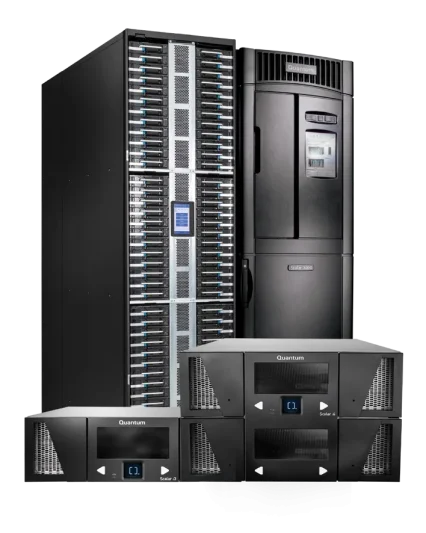
Quantum puts the saving at up to 80% for cold data, compared with keeping it all on disk-based object storage. The Cold class starts at 1 PB. Software that sends objects with Amazon’s DEEP_ARCHIVE class also lands on tape. The libraries are on our Quantum Scalar tape libraries page. Our article on LTO tape for compliance retention in Malta covers the tape side.
How does Quantum ActiveScale protect data from deletion and ransomware?
Quantum ActiveScale protects data with S3 Object Lock, which stops an object from being changed or deleted until a retention date you set. ActiveScale runs Object Lock in compliance mode, the strict form of WORM (write once, read many). Once a retention period is set, nobody can override it or shorten it; it can only be extended.
Versioning keeps the earlier versions of each object, so a file overwritten by ransomware can be restored from the version before. Data is encrypted with AES-256 on the network, and at rest on disk and tape once encryption is switched on at installation, metadata included. Object Lock has to be switched on when a bucket is created, so we agree the buckets and retention periods with you at installation.
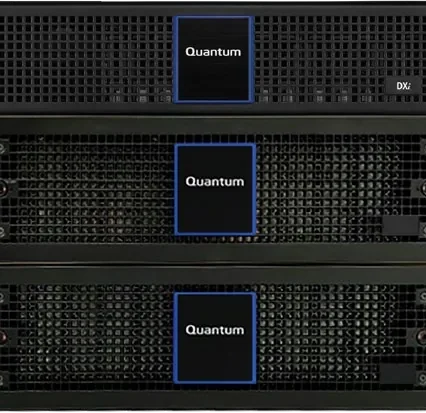
Locked buckets can be replicated to a second ActiveScale system with the same retention policy, or to a public cloud bucket. In Quantum’s own model, Quantum DXi backup appliances take the fast backups, ActiveScale keeps the locked archive and a Scalar library holds an offline tape copy. The Quantum range we supply covers all three.
How durable is data stored on Quantum ActiveScale?
Quantum rates ActiveScale at up to 19 nines of durability (99.99999999999999999%) for both the Active and Cold classes. It explains the figure as losing one object in ten billion every billion years. The rating your system reaches depends on the erasure-coding policy chosen at installation.
ActiveScale gets there with erasure coding. Each object is split into data pieces and parity pieces, spread over separate drives and servers. In Quantum’s example an object is split into 18 pieces, and any five can be lost with the object still readable. ActiveScale checks the pieces in the background and rebuilds damaged ones in parallel, without waiting for a failed drive to be replaced.
New servers join the cluster without the existing data being rebalanced, and upgrades roll through while the system stays online. A single-site system survives disk and server failures. A three-site system (3GEO) keeps serving all data with one data centre down.
Quantum ActiveScale technical specifications
The ActiveScale P200, X200 and Z200 server nodes all run the same ActiveScale software. Figures are from Quantum’s datasheet; raw capacity is before data protection, and usable capacity depends on the erasure-coding policy.
| Specification | ActiveScale P200 | ActiveScale X200 | ActiveScale Z200 |
|---|---|---|---|
| Node type | Hard-disk node | High-density hard-disk twin-server chassis | All-flash NVMe node |
| Form factor | 1U, 12 drives | 4U, 90 drives, two servers | 1U, 10 drives |
| Drives | 18 or 24 TB HDD | 18 or 24 TB HDD | 15.36 or 30.72 TB NVMe SSD; 61.44 TB subject to availability from Quantum |
| Client connectivity | 2 x 10/25 Gb per node | 4 x 10/25 Gb per chassis | 2 x 10/25 Gb per node |
| Entry configuration | 3 nodes, 3U | 4 nodes in twin servers, 8U | 3 nodes, 3U |
| Entry raw capacity | 648 TB (36 x 18 TB HDD) | 1,080 TB (60 x 18 TB HDD) | 460.8 TB (30 x 15.36 TB SSD) |
| Client ports, entry configuration | 6 x 10/25 Gb | 8 x 10/25 Gb | 6 x 10/25 Gb |
| Objects, entry configuration | 1.25 billion | 5 billion | 50 billion (with 100 TB of NVMe for objects; most relevant to Cold Storage systems) |
| Maximum nodes and capacity | No fixed limit | No fixed limit | No fixed limit |
| Size (W x H x D) | 44.7 x 4.3 x 94 cm | 44.9 x 17.7 x 109.1 cm | 43.7 x 4.3 x 59.7 cm |
| Weight as configured | 27.2 kg | 130 kg | 13.02 kg |
| Power, typical / maximum | 0.35 / 0.43 kW | 1.93 / 2.5 kW | 0.46 / 0.54 kW |
| Power supply | 100 to 240 V AC | 200 to 240 V AC | 100 to 240 V AC |
| Specification | ActiveScale software (all nodes) |
|---|---|
| Operating software | ActiveScale OS 7.x |
| Storage classes | Active (S3 Standard-compatible) on HDD or NVMe; Cold (S3 Glacier-compatible) on LTO tape with the ActiveScale Cold Storage option |
| Access protocols | RESTful S3, S3a, NFS v3 |
| Licensed Active usable capacity | From 100 TB; no maximum |
| ActiveScale Cold Storage capacity | Optional, from 1 PB; no maximum |
| Durability (Quantum rating) | Up to 19 nines for both Active and Cold classes |
| Data protection | Erasure coding for Active and Cold classes, Dynamic Data Placement, Dynamic Data Repair, versioning, Object Lock (compliance mode), strong consistency |
| Sites and replication | Single site; 2GEO with per-bucket replication, one-way or both ways, also to public cloud; 3GEO with data spread across three sites; Glacier-to-Glacier replication of cold data |
| Encryption | AES-256 in flight (SSL/TLS) and at rest, object data and metadata; FIPS 140-2 certified option (on request from Quantum) |
| Data services | User accounts, IAM, hard or soft quotas per account, lifecycle policies, object notifications through Kafka |
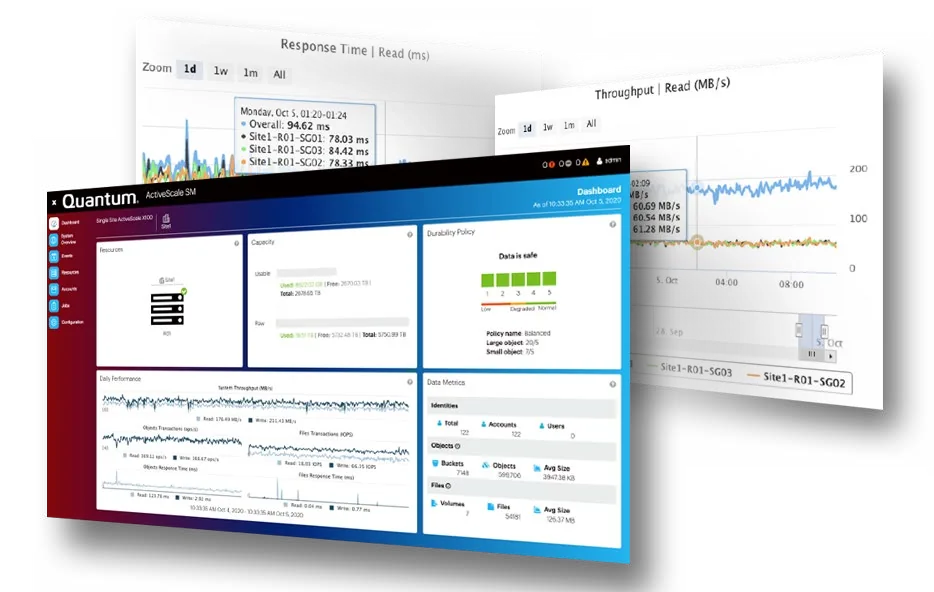
| Management | ActiveScale SM web console, CLI, RESTful API, ActiveScale View; Prometheus metrics with Grafana; Quantum Cloud-Based Analytics |
| Largest object (multipart) | 50 TB |
| Upgrades and expansion | Non-disruptive rolling upgrades of hardware, software and firmware; nodes added without rebalancing |
Download the Quantum ActiveScale spec sheet (PDF)
ActiveScale P200, X200 or Z200: which node fits?
The ActiveScale P200 is the hard-disk entry point. Three 1U servers give 648 TB raw, enough for an archive or backup target in the hundreds of terabytes, and you add nodes as the data grows.
The ActiveScale X200 puts two servers and 90 drives in a 4U chassis, for archives heading into several petabytes. Each chassis is 109 cm deep and weighs 130 kg as configured, so we check rack depth and floor loading before we quote.
The ActiveScale Z200 uses NVMe flash. Choose it when the data is millions of small objects, or as the front end of a large Cold Storage archive. Quantum rates a three-node Z200 system at up to 50 billion objects with 100 TB of NVMe set aside for objects, a figure most relevant to Cold Storage systems. All three nodes take the same software, Object Lock and Cold Storage option.
When is Quantum ActiveScale the wrong choice?
Quantum ActiveScale is the wrong choice for a business with a few tens of terabytes to keep. A system starts at three servers (four on the X200) and a 100 TB licence, and it needs rack space, power, cooling and someone to look after it.
For file storage and backups in a small or mid-sized office, a Synology NAS is simpler to run, and the Synology ActiveProtect backup appliance handles backup in one box. For an offline tape copy, an actiData actiLib 2U or actiLib Kodiak 3416 library is simpler. If backups are slow and restores must be fast, start with a Quantum DXi appliance; ActiveScale can sit behind it later.
A public cloud archive class can also be the better fit when you hold little data and almost never read it back. Quantum’s own white paper makes the same point: public cloud storage pays off only when data is rarely read.
Can we move data from Amazon S3 or Glacier to Quantum ActiveScale?
Quantum ActiveScale uses the same S3 interface as Amazon, so software that writes to Amazon S3 can be pointed at an ActiveScale bucket instead. Quantum states that the vast majority of applications designed for AWS work with ActiveScale without modification. Software that uses the S3 Glacier class can use ActiveScale Cold Storage as it is, with the same restore request it sends to Amazon.
Copying the data you already hold in Amazon is a separate step. The route depends on how much there is, which software wrote it and the speed of your internet link, so we plan it with you before we quote.
A cloud copy can also stay. ActiveScale replicates a bucket, asynchronously, to a bucket in Amazon S3 or another S3-compatible service. It can also replicate cold data to the Amazon S3 Glacier service. Between two ActiveScale systems, replication runs one way or both ways. Reading data back from your own ActiveScale carries no access or restore fees.
What drives the cost of a Quantum ActiveScale system?
The Quantum ActiveScale licence starts at 100 TB of usable capacity on the Active class. Each system is sized to your data, so the price in Malta is on request. The licensed capacity covers what you hold now and how fast it grows. The node type and count follow from it: P200, X200 or Z200, and how many.
The erasure-coding policy decides how much raw disk a given usable capacity and durability need. Cold Storage, from 1 PB, adds the Scalar libraries, LTO drives and tape cartridges. A second site adds a replicated copy. Quantum support and our installation work come on top.
Running cost is mainly power and cooling. The datasheet gives 0.35 kW typical for a P200 node and 1.93 kW for an X200 chassis. On your own system there are no access fees for reading data back or moving it between the Active and Cold classes.
How we set up Quantum ActiveScale in Malta
Our sales team works out the Quantum ActiveScale configuration with you. We start from four facts: how much data you hold, how much of it is cold, which applications will write to it and how long it must be kept.
Our technical team installs and commissions it. We rack the nodes and cable the client network, with at least two configured client ports for high availability. We then set up accounts and buckets, the Object Lock retention and lifecycle rules, and connect your backup or archive software.
Plan for an air-conditioned room and a UPS; we supply Eaton UPS units sized to the rack. The X200 needs a 200 to 240 V supply.
Frequently asked questions about Quantum ActiveScale
What does it cost to keep data on Quantum ActiveScale?
Quantum ActiveScale is a system you buy, with no access or restore fees on your own hardware, so the bill does not rise each time you read data back. For cold data, Quantum quotes up to 80% lower cost on ActiveScale Cold Storage than on all-disk object storage. That comparison is with disk, not with a cloud archive. We price a sized system against what you pay today.
Does Quantum ActiveScale work with our current backup software?
Quantum ActiveScale works with backup and archive software that can write to S3-compatible object storage. Quantum states that most applications written for Amazon S3 work with ActiveScale unchanged, and software that uses the S3 Glacier class can use Cold Storage as it is. We check your product and version before we quote. If compatibility is in doubt, Quantum can give access to a physical or virtual ActiveScale system for testing.
Does ActiveScale help with DORA, NIS2 or MGA retention rules?
Quantum ActiveScale keeps data under Object Lock in compliance mode, so it cannot be changed or deleted before its retention date, and versioning keeps earlier copies. Encryption protects data on the network and at rest. Your policies and restore testing stay with you. For an offline copy the network cannot reach, add a Scalar library with Active Vault. Our iGaming and finance pages cover those sectors.
Who installs it in Malta?
Quantum ActiveScale is installed and commissioned by our technical team. Object Lock has to be enabled when each bucket is created, so we agree the buckets and retention rules with you before any data arrives. If Cold Storage is part of the order, the Scalar libraries go in at the same time.
Who repairs it and handles the warranty?
For Quantum ActiveScale, you report the fault to us and we take the warranty and repair case up with Quantum. ActiveScale repairs affected data in the background without waiting for a replacement drive, so a drive fault does not stop the system serving data. The warranty and support terms for your system are set out in the quote.
Is it held in stock in Malta?
Quantum ActiveScale is specified for each site, from the node type and count to the tape libraries for Cold Storage. Once you approve the configuration, its delivery date is confirmed in the quote.
Talk to us about an ActiveScale archive
Tell us how much data you hold, how fast it grows, how much of it is still read after a few months and how long it must be kept. We reply within one working day with the questions we still need answered. If the site needs a look, an engineer visits, anywhere in Malta and Gozo. You get a quote with the configuration, the installation scope and the support route.
Request a quote for Quantum ActiveScale or call (+356) 2138 5911 · Price on request
Monday to Friday 8:30 to 16:30. We reply within one working day.
We have been part of Maltese IT and industry since 1981.
Related Products
Talk to us about your next project
Tell us what you need to run, code, label, store, protect or automate. Our technical sales team in San Gwann replies within one working day, in Maltese or English.
Who you deal with:
- Part of Maltese IT and industry since 1981
- A sales team that specifies the right part codes
- A technical team that installs, tests and repairs
- Engineers on site anywhere in Malta and Gozo
- Zebra Premier Business Partner, Synology Platinum Partner
- Distributor for Eaton and Domino in Malta
What happens next?
We reply within one working day
An engineer visits if the site needs a look
You get a quote with part codes, installation and warranty